One Difficult Paragraph, Read Slowly
Read one difficult paragraph slowly to identify its claim, trace how its sentences connect and write a clearer account without losing important qualifications.
The common mistake with one difficult paragraph is to read it again from the beginning and hope the meaning will suddenly appear. That costs attention without changing the problem: perhaps one phrase is unfamiliar, or perhaps the sentences do not seem to fit together. A better approach gives each pass a job: locate the claim, trace the reasoning and restate it plainly.
Take a pencil, mark-up tool or plain text note. You are not looking for hidden meanings in every phrase; you are working out what the writer says and how the sentences support, limit or develop that point.
Separate an unclear claim from an unfamiliar phrase
Read the paragraph once without marking it. Then ask what the writer wants you to believe, notice or reconsider. Look for the sentence that carries the paragraph’s main point; it may come at the start, at the end or after a contrast.
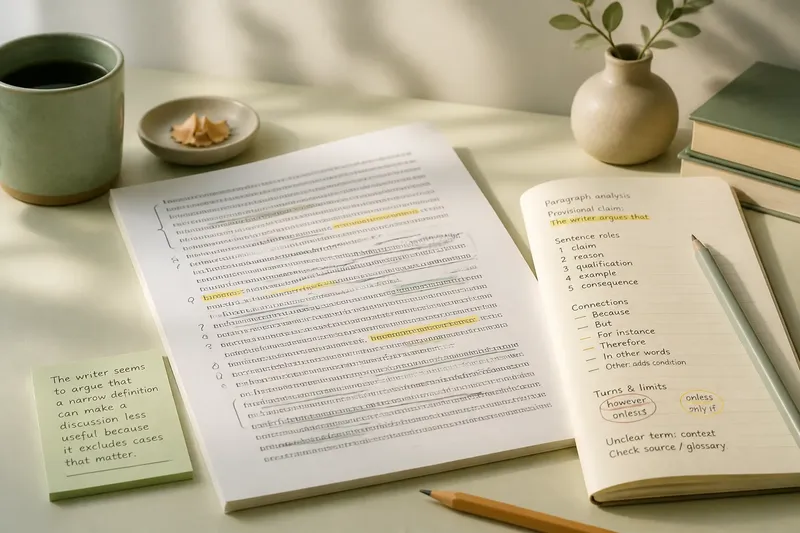
Write a provisional version in the margin: “The writer seems to argue that…” If you cannot finish the sentence, mark the two or three lines that seem central and leave the rest for now. A tentative claim is more useful than a confident guess.
Sometimes the point depends on a previous paragraph. Note what context seems missing instead of silently filling the gap with your own assumption. This keeps your reading open to correction.
Give each sentence a job
Repeated words can make a paragraph seem circular, even when each sentence adds something. One may state a claim, another give a reason, and a third qualify or illustrate it. Beside each sentence, jot a short label such as “claim”, “reason”, “qualification”, “example” or “consequence”. Treat these as working notes, not fixed categories.
Then check the connection between neighbouring sentences with a prompt:
- Because: Does this sentence give a reason for the previous claim?
- But: Does it challenge or limit what came before?
- For instance: Does it make an abstract point more concrete?
- Therefore: Does it draw a consequence?
- In other words: Does it restate an idea with a different emphasis?
Use a prompt only if it fits the wording. If none does, describe the link in your own words, perhaps “adds a condition” or “shifts from an example to a general point”. That note can reveal the paragraph’s structure without forcing it into a formula.
Mark the turns that alter the claim
Short words such as “however”, “although”, “unless” and “only if” can change the direction or scope of a sentence. Circle them, then ask what the writer says before the turn and what changes afterwards.
Compare “this explanation applies” with “this explanation applies when the earlier condition holds”. The second claim has a limit. Keep such limits beside your claim note so your account does not make the writer sound more absolute than they are.
Pronouns can create a different snag. If “this” might refer to either the previous example or the writer’s conclusion, write down both readings and see which makes the next sentence coherent. You need not settle the question until the text gives you a reason.
Trace the reasoning without supplying missing support
A clear claim and a clear reason do not always make a clear argument. The connection between them may be unstated, or the paragraph may rely on a point made elsewhere. Write two notes: “The writer says…” and “This supports the claim because…”. If the second is hard to complete, you have identified a gap to examine.
Say you are reading an invented paragraph that claims a narrow definition can make a discussion less useful because it excludes borderline cases. The paragraph’s intended reasoning is that some borderline cases matter to the discussion, so leaving them out can make the discussion less useful. Restating the link this way clarifies the claim; it does not show whether the paragraph has offered enough support.
Mark an unresolved link with a question mark and check the neighbouring sentences for an explanation or qualification. If none appears, separate understanding the writer’s argument from accepting it. Close reading can clarify a claim without deciding whether it is sound.
Use context carefully when a term is unfamiliar
When a phrase blocks the argument, look nearby for a contrast, explanation or example that suggests how the writer is using it. Note that local meaning without treating it as a complete definition.
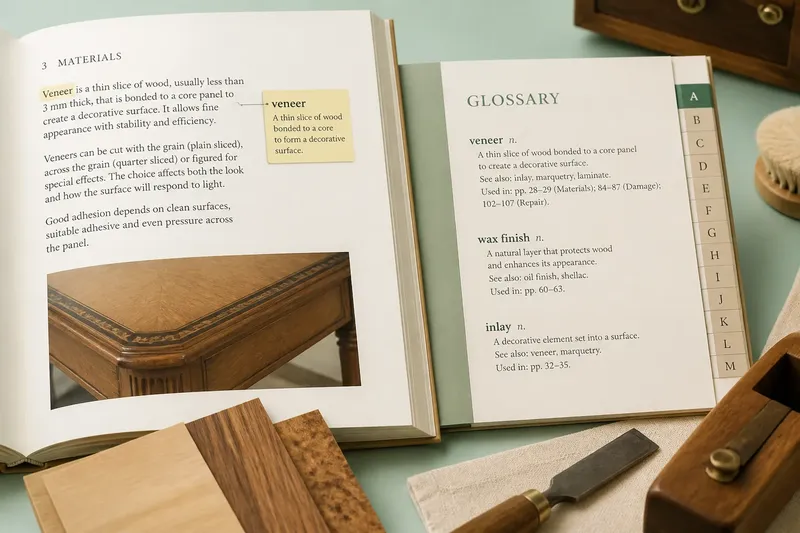
If the term remains central and unclear, consult a glossary or the source’s earlier explanation. Check that the reference belongs to the same subject or text, then return to the paragraph and see whether the reasoning now connects.
It is not worth chasing every unfamiliar word into a long chain of background reading. Look up what blocks the argument; leave a minor term for later if the claim and sentence links still make sense. A note saying “term unclear” is better than quietly substituting a meaning that may not fit.
Build a paraphrase from your notes
Put the source aside briefly and use your claim note and sentence labels to draft a simpler account. Keep the writer’s conditions and contrasts, but choose ordinary wording where it preserves the same idea.
Compare your draft with the paragraph. Check whether you have turned an example into a general rule, dropped a limit or made an implied connection sound certain. If a key term has no safe substitute, retain it and explain its role in plain language.
A useful paraphrase does not have to be shorter. It should make clear what the writer claims, what support they offer and how the sentences connect. If one part of your account has no clear source in the paragraph, mark it as your own inference.
What helps when the argument remains unclear?
Should I treat the first sentence as the claim?
Not automatically. An opening sentence may introduce a problem or describe a familiar view before the writer states a position. Read to the end, then ask which point the other sentences support.
What if several sentences seem equally important?
Try combining their shared point in one sentence without copying the wording. If that does not work, record both the main claim and its qualification, or note that the paragraph may be doing two jobs.
How can I tell whether an example supports the claim?
Identify the feature of the example the writer wants you to notice, then connect it to the claim in your own sentence. If that connection requires an assumption the paragraph does not provide, note that the example illustrates a point but may not fully support the broader claim.
When should I reread the surrounding text?
Check the neighbouring sentences when a pronoun has no clear referent, a term seems to rely on an earlier explanation or the paragraph answers a question that is not stated on the page. Look for that specific missing piece instead of restarting the whole reading.
Keep a compact record of the argument
Finish with a short note containing the claim, its main reason and any limit that changes its scope. Add a question mark beside what remains uncertain. This gives you a clear route back into the paragraph without copying it line by line.
For one difficult paragraph, read with a purpose: find the claim, trace each sentence’s contribution, inspect the connections and write a plain account. Keep uncertain points visible rather than smoothing them away. When you return to the text, your notes should show both what you understand and exactly what still needs checking.